Game 2 of the World Series ended on a call nobody could review.
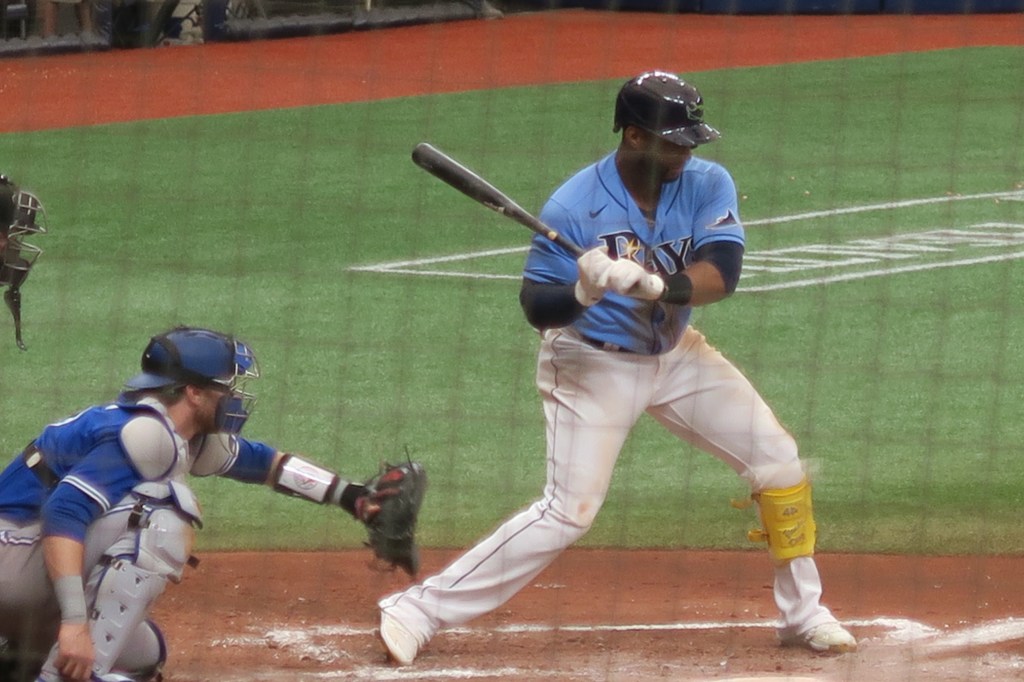
With two outs in the top of the ninth, the Brewers ahead 5-4 and the tying run on third, Yandy Díaz worked a full count against Brewers left-hander Aaron Ashby. He started to go after a curveball, then tried to hold up. Plate umpire Jim Wolf ruled no swing, which would have been ball four. Brewers catcher William Contreras appealed to first-base umpire James Hoye, who ruled that Díaz had gone around. Strike three. Game over. The Brewers won 5-4 at American Family Field on Saturday night and took a 2-0 lead in the Series.
“In the moment, yeah, I disagreed. But the umpire said it was a swing and it is what it is,” Díaz said afterward, per NBC News. Rays manager Kevin Cash didn’t argue it: “I didn’t go look at it, but from my vantage point, it did look like that he swung.”
The Rays had no recourse. Check swings aren’t on MLB’s list of reviewable plays, and the official rules don’t define a check swing at all. A swing comes down to whether the umpire thinks the batter “struck at” the pitch. Fox play-by-play voice Joe Davis said on the broadcast: “We got ABS for the first time this year, getting the balls and strikes right. We need to get a system that can get [checked swings] right.”
MLB has a system like that. It just isn’t in the majors yet.
What MLB has been testing
The Check Swing Challenge uses the same Hawk-Eye tracking as the ABS Challenge System that MLB brought to the majors this season.
- Arizona Fall League, 2024. MLB first tested it as a proof of concept, only at Salt River Fields. MLB.com reported that each team got two challenges per game, plus one more for the ninth inning if it had used both. Only the batter, pitcher or catcher could challenge. On Oct. 22, 2024, Mets prospect Drew Gilbert tapped his helmet for the first check-swing challenge in pro baseball, and the swing call was overturned to ball four.
- Single-A Florida State League, 2025. The test moved to the FSL on May 20, 2025, with one challenge per team that a club kept if it won. “This is an early step in our testing process,” MLB vice president of baseball operations Joe Martinez said at the time. “At this stage, we are determining whether the technology works for this purpose and experimenting with different ways of weaving it into the game.”
- Triple-A Pacific Coast League, 2026. The PCL added check-swing challenges in early May this season. Teams start with two challenges they can use on either ball-strike or swing calls, but not both on the same pitch. In the other Triple-A league, the International League, umpires were told to call check swings by the same standard, but players can’t challenge them, according to Baseball America.
The standard is the key part. Under the test rules, it’s a swing only if the bat head moves more than 45 degrees past the knob. That’s the same angle as the foul lines. For a right-handed hitter, the barrel has to go past the first-base line. For a lefty, it has to go past the third-base line. That’s a far more hitter-friendly line than most fans picture when they yell “he went!”
The results MLB has released so far are limited. The league says that in the 2025 tests, the strikeout rate was more than 3% lower when the Check Swing Challenge was used, leading to more balls in play. MLB hasn’t published official totals for how many check-swing challenges were made in the PCL this season, how often they were overturned, or how long a check-swing review takes.
For comparison, MLB says ABS challenges in 2025 spring training took an average of 13.8 seconds. And ABS’s first big-league season went well enough to shape this debate. In the 2026 regular season, teams made 10,557 ABS challenges, and about 54% were overturned, according to MLB’s Baseball Savant. Baseball-Reference’s breakdown has catchers winning 58.6% of their challenges, batters 48.8% and pitchers 39.6%, on just 182 tries.
Would it have changed Game 2?
There’s no official answer. MLB hasn’t run Díaz’s swing through the system publicly, and the 45-degree standard isn’t the major league rule.
Some outside analysts think he would have walked. Baseball America’s JJ Cooper posted on X that “if current ABS check swing rules (as used in parts of MiLB) were in place this would not have been a swing.” FanSided and Chosun Biz reached the same conclusion from the replay. Those are unofficial readings of broadcast video, not Hawk-Eye measurements.
Is it coming to the majors?
Not on any announced timeline. MLB said in March that this year’s minor league experiments are “simply experimental, with no imminent arrival in the Majors.” In 2025, Commissioner Rob Manfred said the league wanted to settle ABS first: “We haven’t made a decision about the check swing thing. We do try to think sequentially about what’s coming out.”
ABS is settled now. But MLB hasn’t announced any plan to bring check-swing challenges to the majors in 2027, and the collective bargaining agreement expires Dec. 1, with a lockout widely expected.
The view from the mound
As a pitcher, I want every call to go my way, right? So from a pitcher’s point of view, the umpire was right.
I used to be more old school about this. Human error was part of the game. But I’ve slowly come around, with the ABS challenge and the manager challenge. Now I think that if we have modern technology, we might as well use it in all situations possible, especially in World Series games.
That includes a play like this one. I’d be in favor of letting teams challenge a game-ending call like this one, so that if the call is wrong, the game keeps going. MLB has been testing the technology in the minors since 2024. The biggest games of the year are where it matters most.
Related: Cooper Pratt’s go-ahead hit in Game 2 · Freddy Peralta Has to Beat the Team That Built Him
Featured photo: Yandy Díaz in a 2021 archive photo. Photo: Jeff Marquis / Flickr, CC BY 2.0 (archive, July 11, 2021).


Leave a Reply